Goal Setting
Goal Setting: A Simple Guide to Setting Goals You'll Actually Reach
Every January, I write down a handful of goals. By summer, I can only remember some of them. If that sounds like you, this plain guide to goal setting is the one I wish I had years ago.
What is goal setting?
Goal setting is deciding what you want and making a simple plan to reach it.
It works for your personal life too, not only your job. A good goal gives you two things: a direction to move toward, and a way to see if you are making progress.
That plan matters more than most people think. In a summary of 35 years of research, psychologists Edwin Locke and Gary Latham studied what makes goals work. In roughly 90% of studies, specific and challenging goals led to higher performance than "do your best" goals or no goals. That figure is the share of studies, mostly in work and lab settings, so treat it as a strong pattern rather than a promise.
Why most goals fade (and why that isn't your fault)
You are not the only one who loses steam. According to a 2024 Pew Research Center survey of 5,140 US adults, three-in-ten Americans report making at least one resolution this year.
Staying with those goals is the hard part. A Forbes Health survey of 1,000 US adults found the average resolution lasts just 3.74 months, so most fade before spring.
Two things usually get in the way. The goal was too vague to act on, and life got busy. Then one missed week turns into guilt, and guilt makes you avoid the whole thing.
None of that means you lack willpower. It means the old way of setting goals asks a lot and hands back very little.
Start with a vision, then set goals
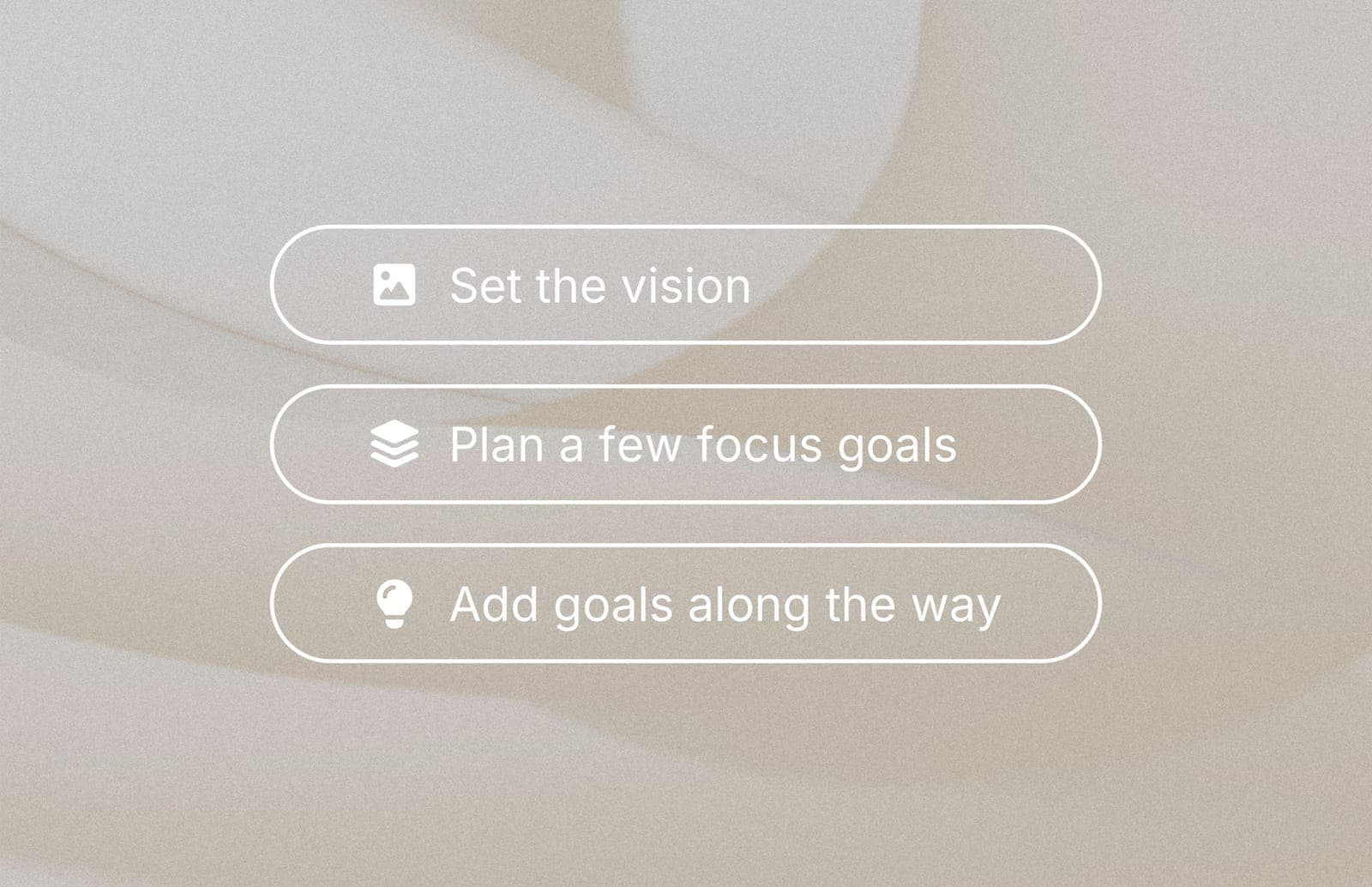
Before you set a single goal, I want you to start with a vision. A vision is the feeling and the direction you want for your year. Goals are how you get there.
Here is what I mean. A vague wish sounds like "I want to be healthier." A vision sounds like "I want to feel strong and focused when I wake up."
Once you can feel that picture, the goals almost pick themselves. You are choosing steps toward something real, not filling in a form.
I keep my vision somewhere I actually want to look, like a small board of quotes and images. When a busy week hits, that picture reminds me why the goal was worth setting in the first place.
How to set a goal, step by step
Once you have a vision, setting a goal is simpler than it looks. I use a short method built for one person planning a real life, not a team writing a report.
Here are the four steps:
- Pick what matters most right now.
- Make it specific.
- Break it into steps you can do this week.
- Plan a gentle monthly check-in.
The next three parts walk through the steps that trip people up the most.
Make it specific (the SMART idea, in plain words)
You may have heard of SMART goals. It is a simple checklist: specific, measurable, achievable, relevant, and time-bound. In plain words, a SMART goal says exactly what you will do and by when, in a way you can measure.
A vague goal like "read more" is hard to start. A specific goal like "Read 15 pages before bed on weekdays" tells you what to do tonight.
Here is the same idea across a few common goals:
| Vague goal | Specific goal |
|---|---|
| Read more | "Read 15 pages before bed on weekdays" |
| Save money | "Move $40 to savings every Friday" |
| Get fit | "Walk 30 minutes after lunch, four days a week" |
If you want a longer walkthrough, here is how to write a SMART goal without the jargon.
Break it into steps you can do this week
A specific goal can still feel too big to start. The fix is to break goals into steps small enough to do this week.
Say your goal is "Run a 5K by June." Your first actions could be:
- Buy running shoes this weekend.
- Walk for 20 minutes on Tuesday morning.
- Download a beginner running plan.
- Tell one friend you started.
This is the part where I stall the most, so I built Fred to help. You describe a goal in your own words, and Fred AI turns it into a short list of steps you can act on today. Fred also keeps a library of more than 200 goals you can browse when you feel stuck.
Write it down
Keep one habit no matter what: write your goal down.
In a study by Dominican University, psychologist Gail Matthews found that those who wrote their goals accomplished significantly more than those who did not. Participants who wrote their goals scored about 42% higher on a goal-achievement scale than those who only thought about them.
A written goal stops being a fuzzy idea in your head. It becomes something you can see, check, and adjust.
Choose fewer goals than you think you need
Here is the mistake I make every January: I write a long list. A long list feels ambitious, and then it quietly turns into a pile of things I may forget.
Pick two or three goals for the month, no more. Fewer goals means each one gets real attention and far less of the overwhelm that makes you quit.
That is why I plan in months, not only years. A month is long enough to make progress and short enough to stay honest. If you want help narrowing down, here is how to choose realistic goals you will actually finish.
Stay on track without the pressure
Two habits help more than any streak counter:
- Check in monthly: Look at your goals once a month, keep what still matters, and let go of what does not.
- Tell a friend: Share your goal with someone who will cheer you on and ask how it is going.
The second habit has real weight behind it. In the same Dominican University research, the group that wrote their goals, committed to specific actions, and sent weekly progress reports to a friend did best: 76 percent accomplished their goals or got at least halfway there. That compared to 43 percent of the group who kept unwritten goals to themselves.
So share goals with friends who want to see you win. A short monthly look-back also beats a rigid daily streak, and here is why monthly goal reviews work better than resolutions.
Fred works this way on purpose. Each month starts clean, with no streak to protect and no guilt for a missed day.
Why naming your goal matters
Naming a goal, on paper or out loud, changes your odds. In University of Scranton research, psychologist John Norcross tracked people for six months. At that point, 46% of the resolvers were continuously successful compared to 4% of the nonresolvers.
That is a big gap, and it is also honest. Just under half of the goal-setters were still on track, which tells you follow-through is hard for everyone.
Naming your goal will not make it automatic. It does put you in a far stronger spot than a vague wish that never leaves your head.
So say it plainly. Write down the one goal you care about this month, then put it where you will see it. That small act of naming is where real progress starts.
Conclusion
Good goal setting is simpler than it sounds. Start with a vision, choose a couple of specific goals, and break each one into steps you can do this week.
Then check in once a month and adjust what needs adjusting. You do not need the whole path today.
You just need the next small step. Start this week, with one goal.
Set your next goal with Fred
I built Fred for exactly this. It turns your vision into a few monthly goals. Fred AI then generates concrete steps, and each month resets clean with no streak pressure. Fred's free plan makes it easy to try. Get started today and start setting goals with Fred.
Frequently asked questions
Goal setting means deciding what you want and making a simple plan to reach it. It gives you both a direction to move in and a way to measure your progress.
Pick what matters most, make it specific, break it into steps you can do this week, and plan a gentle monthly check-in.
Goal setting gives your time a clear direction and turns a big ambition into small, doable actions. That makes real progress much easier to see and to keep going.
A good example is "Read 15 pages before bed on weekdays," because it says exactly what to do and when, so you can start tonight.