Goal Setting
What Personal OKRs Are and How to Set Ones You'll Actually Finish
It is a Sunday evening in early January. You have a warm drink, a fresh notebook, and a short list of things you swear will be different this year.
Fast forward to March. The notebook is in a drawer, and you cannot quite remember what you wrote.
I have lived that gap more times than I want to admit, which is part of why I built Fred. Along the way I found a simple tool that helps those January wishes turn into real progress: personal OKRs.
They started in the office, but they work surprisingly well for a regular life. Let me show you what they are and how to set ones you will actually finish.
What are personal OKRs?
Personal OKRs are Objectives and Key Results applied to your own life. The objective is what you want, written in plain and motivating words. The key results are the measurable signs that you actually got there.
A personal OKR is different from a bucket list, which collects dreams with no way to measure them. It is also different from a to-do list, which tracks small tasks with no bigger reason behind them.
Think of it as a small, honest promise you make to yourself. It should feel lighter and more pleasant than a work review.
One of the clearest examples I know comes from John Doerr, the investor who taught OKRs to Google. In Doerr's family dinner OKR, the objective was to have more quality family time, measured by two key results:
- Get home for dinner by 6 pm, 20 nights a month.
- Be fully present by turning off the internet router.
Where OKRs came from (a 30-second history)
OKRs did not start with self-help. The method came from the tech world, and the story is short.
This OKR origin history explains that Andy Grove introduced the approach at Intel in the 1970s. He built on Peter Drucker's Management by Objectives, and John Doerr later carried the method to Google.
Under Grove's leadership, Intel did very well. The figures on Intel revenue under Grove note that the company increased revenues from $1.9 billion to $26 billion. OKRs were one habit among many there, so I would not credit them alone.
Why personal OKRs work
So why borrow an office tool for your personal life? For me it comes down to two things. Personal OKRs help you move on goals that matter but never feel urgent, and they show you real progress.
Most important goals are quiet. Nobody emails you about getting fit or learning the piano, so those goals lose to the loud, urgent stuff.
A personal OKR puts them on the board with a clear finish line. Once a quiet goal has that finish line, it stops being a someday wish and becomes this month's work.
There is a research angle too, and it is worth a short mention. Across decades of goal research, psychologists Edwin Locke and Gary Latham found that clear targets beat vague ones. Their 35-year review of goal-setting research puts it plainly:
"We found that specific, difficult goals consistently led to higher performance than urging people to do their best." (Locke and Latham, American Psychologist, 2002)
Sharing your goals seems to help as well. In a four-week study of 149 adults with workplace goals, Dr. Gail Matthews of Dominican University tested accountability. The Dominican University goals study reported that:
"More than 70 percent of the participants who sent weekly updates to a friend reported successful goal achievement, compared to 35 percent of those who kept their goals to themselves." (Dominican University of California, 2015)
Here is the part I care about most. Personal OKRs work best when they make you feel more focused and clearer, so guilt goes down instead of up.
The two parts of an OKR: objectives and key results
Let me slow down on the two pieces, because getting them right is most of the battle.
An objective is where you are going. Keep it short and a little inspiring, the kind of line you would be happy to read on a Sunday.
A key result is a measurable sign you got there. Aim for two to four of them, each one clear enough that you can mark it done or not done.
| Objective | Key results |
|---|---|
| What you want, in plain words | How you will measure getting there |
| Short and motivating | Specific and numeric where you can |
| One per OKR | Usually two to four |
| Answers "where am I going?" | Answers "how will I know?" |
People often ask about the "five elements" of an OKR. The simple version is one clear objective plus a few measurable key results, each one you can verify as done or not.
If you want your key results to be sharp, it helps to write SMART goals for each one. Keep the list short, though. Two key results fit a real life, while ten turn your month into a spreadsheet.
Personal OKR examples across your life
Examples make this click faster than any definition. Below I will walk through worked examples, starting with fitness and ending with wellbeing.
Learning fits the same shape, if you want a quick one first. An objective like "Read more and remember it" could use two key results: finish four books this quarter, and write a short note on each one.
A fitness OKR
Say you want to get moving again. The objective could be "Feel strong and finish my first 10K."
The key results give it teeth:
- Run three times a week, every week of the cycle.
- Add one mile to your long run each week.
- Finish the race under a target time you pick.
The trick is to start from the feeling, then attach steps. If the plan feels too big, it helps to break goals into steps so the first run is obvious.
A career or skill OKR
Now a work-flavored goal that is still personal. The objective might be "Grow into a confident public speaker."
Good key results here could be:
- Give four talks this quarter.
- Complete one speaking course.
- Average 7 out of 10 on audience feedback.
This one is yours to define. You pick the target because it matters to you, and you decide when it counts as done.
A wellbeing OKR (measuring the intangible)
Soft goals scare people off because they feel impossible to measure. They become doable once you accept a "good enough" proxy.
Say the objective is "Feel more relaxed and better rested this month." You cannot put a number on feeling relaxed directly, so you measure something close to it:
- Rate each day and journal, then count the good days.
- Count the relaxing days you have had.
- Note how many nights you got seven hours of sleep.
None of these are perfect, and that is fine. If your objective still feels fuzzy, Fred AI can turn vague goals into steps you can actually check off.
How to write your personal OKRs, step by step
Ready to write your own? Here is the process I use, kept deliberately light.
- Pick one honest objective for the period. One is plenty when you are starting.
- Write two to four key results that prove you got there.
- Make each one a stretch, so success is likely but not guaranteed.
- Focus on what you want to finish, not on what is already handled.
That last point matters. If a key result is already handled, it is not teaching you anything.
Stretch goals raise a fair question: how hard is too hard? For aspirational OKRs, Google's OKR guide gives a benchmark worth borrowing:
"The 'sweet spot' for an OKR grade is 60% – 70%; if someone consistently fully attains their objectives, their OKRs aren't ambitious enough and they need to think bigger." (Google re:Work)
So hitting everything, every time, is a sign to aim higher. Missing a little is normal and expected.
Choosing your cadence: yearly vision, monthly focus
Most OKR advice says run them quarterly. That is the office standard, and it makes sense for a company reporting every three months.
For a personal life, a full quarter is a long time. Motivation fades, life shifts, and a goal you set in January can feel wrong by March.
Fred keeps the big picture close and organizes the work by month and year. A quarter is a long time to hold one plan. A month is close enough to act on.
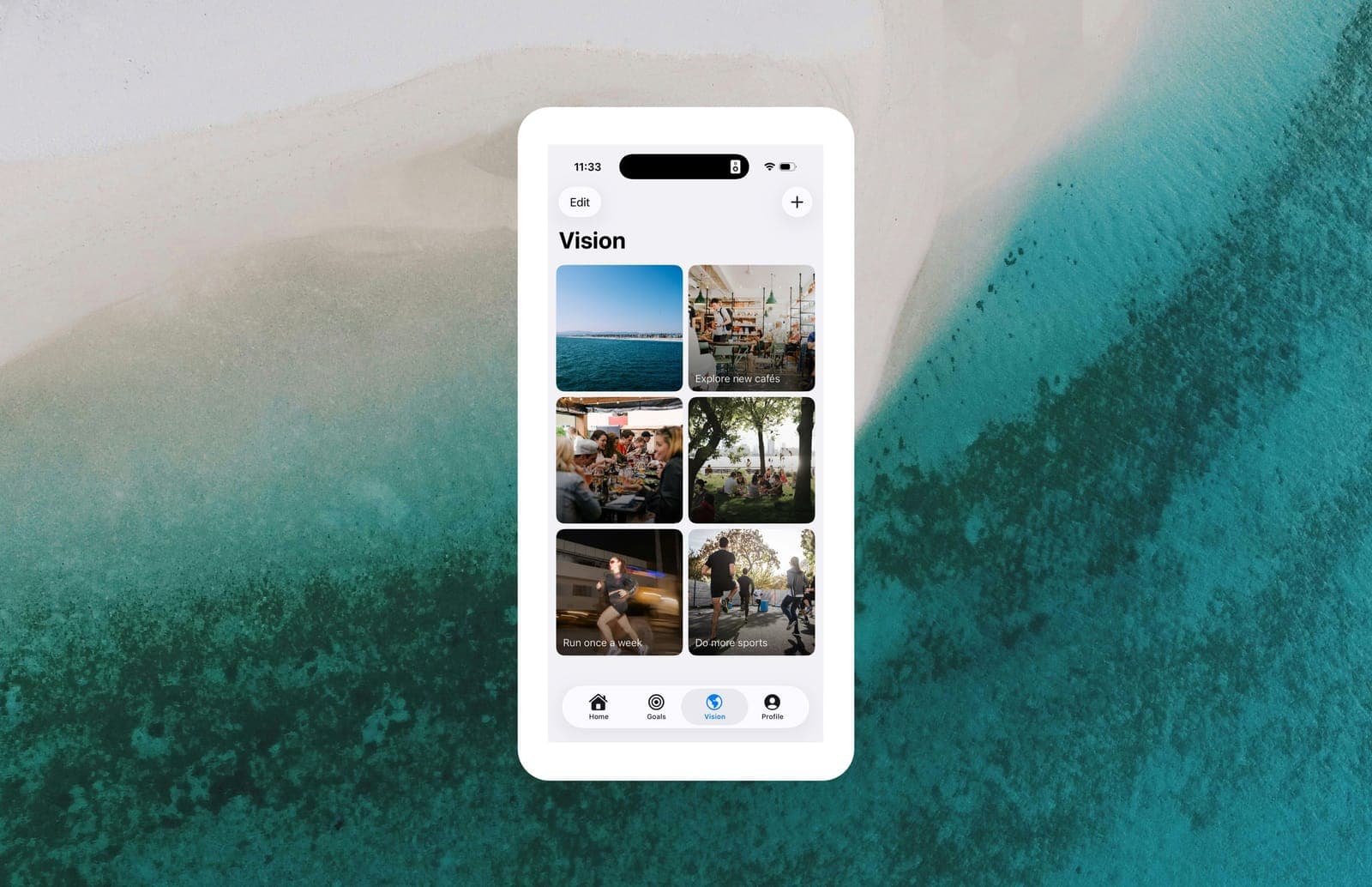
The vision is the feeling you want the year to have, which is why vision boards matter before you set anything. Each month, pull one slice of that vision into one or two goals, then start fresh thirty days later. If you want a walkthrough, here is how I plan a year and break it into months.
Tracking and reviewing without burning out
A goal on paper does nothing without a rhythm to check it. The good news is the rhythm can be tiny.
Once a week, spend five minutes looking at each key result and giving it a color. Green means on track, red means stalled, and yellow means the wobbly middle. That is your whole dashboard, and it fits on a sticky note.
Sharing helps too, as that Dominican study hinted. A quick weekly note to a friend keeps you honest, and I wrote more about sharing goals with friends if you want a nudge.
Here is the rule I keep. When you miss a check-in, you start again. A paused week is not a failed goal. Put it on hold if the month no longer fits, and come back when it does.
Around the 15th, or at the end of the month, close the cycle on purpose. Notice what moved, grade each key result, and carry one lesson forward. That is the point of a monthly goal review, and it beats waiting for next January.
Common mistakes to avoid
A few traps catch almost everyone the first time. Watch for these.
- Key point: Do not turn key results into a task list. They track outcomes, so keep the chores off it.
- Key point: Remember that measurable does not always mean a number.
- Key point: Skip cascading a company's OKRs onto your personal life, since your goals are your own.
Start your first personal OKR this month
Let me bring it home. A personal OKR is one honest objective plus a handful of measurable key results, checked lightly and reviewed with kindness.
Pick one thing that matters this month. Write two to four ways you will know you got there, keep the cadence gentle, and forgive the weeks that slip.
Start with Fred today
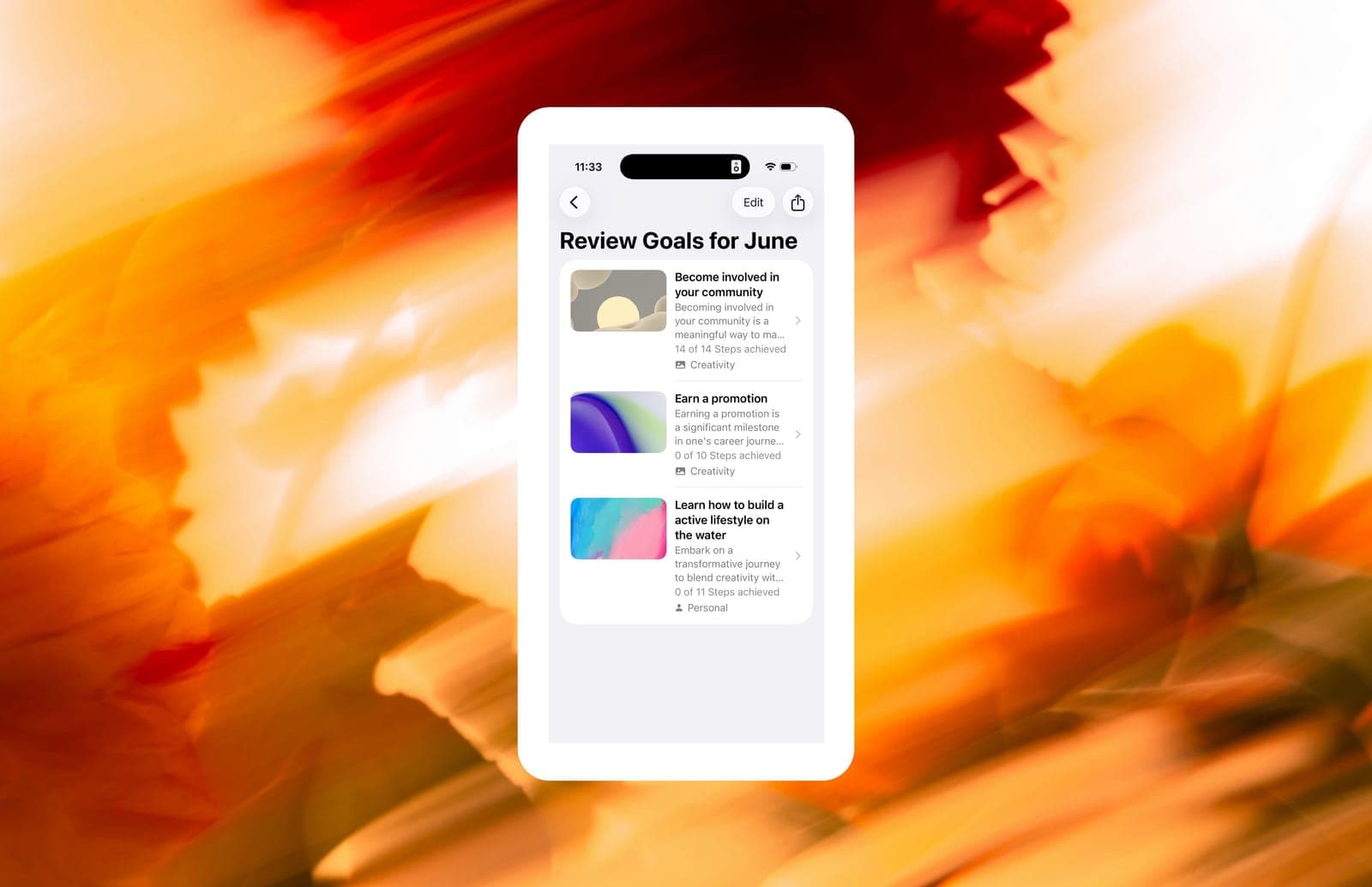
Write the objective as the goal, in your own words, and add the key results beside it. Fred turns that goal into concrete steps, generated for you and ready to start. The vision board keeps the big picture close, and the goals sit by month so the year stays clear.
The free plan includes up to four goals. Fred Pro includes unlimited goals, at €4 a month or €40 a year. You do not need the whole plan tonight. Pick one objective, add two to four key results, and start with Fred today.
Frequently asked questions
Yes, they adapt well to personal goals as long as you keep them separate from your work OKRs and bring a little self-compassion along.
A short look once a week is enough to see whether a key result is moving. Then take about fifteen minutes around the middle of the month and decide what the next month needs. If you miss a week, start again.
Pick a "good enough" echo for the feeling you want. Daily mood ratings, a count of content days, or a clothing size all work well.
Yes, when they add focus and honesty to what matters to you. Skip them if they turn into a source of pressure rather than clarity.