Product Positioning
What Is AI Goal Setting? A Simple Guide to Goals You'll Actually Reach
You know what you want for the year. The missing piece is the first step.
AI goal setting is using a tool to turn a goal you describe in plain words into a short list of steps, then keeping an eye on which of those steps you finish. You type what you want. The tool hands back a move you can start today.
I built Fred for that gap. The vision was clear. The Tuesday evening was not.
What is AI goal setting?
Think of it as a translator. It takes "I want this" and gives back "here is what I do first."
It helps most when the picture of the life you want is already there, and the how is still blank. A vague line like "stay connected" or "become more resilient" is a real goal. It is also hard to begin, because nothing in the sentence tells you what to do this week.
Everyday AI use is climbing, which makes this a fair moment to point it at something personal. In a Pew Research Center survey from September 2025, 21% of U.S. workers said at least some of their work is done with AI, up from 16% a year earlier. The tools are familiar. The useful question is whether they can plan a step you will actually take.
Why setting a goal is easy and reaching it is hard
Deciding feels good. Doing is the hard part. That space has a name: the intention-behavior gap, the distance between what we plan and what we do.
Look at resolutions. In a Pew Research Center survey taken less than a month into 2024, 59% of adults who made a resolution said they had kept all of them so far, 28% had kept some, and 13% had kept none. Even the early weeks lose people.
What closes the gap is planning the when and the how. Psychologists Peter Gollwitzer and Paschal Sheeran reviewed 94 tests of implementation intentions, the small "if this, then that" plans. The meta-analysis found a medium-to-large effect on goal attainment (d = .65).
The reasons people fall behind are usually simpler than laziness. The goal was vague, and life got loud. That is the problem AI goal setting is for.
How AI goal-setting tools work
The flow is short.
- You type a goal in your own words.
- The tool drafts ordered steps.
- You keep what fits, change the wording, and remove the rest.
"Stay connected" might become: text one friend on Sunday, or book a call every other week. The goal now has a door.
The plan stays yours. Fred suggests the steps. You decide which ones are real. A little context helps: a deadline, and how much time the week actually has. The steps come back closer to a life you can live.
The frameworks underneath the steps
AI does not invent goal setting. It leans on methods people have tested for decades. Knowing them helps you tell a useful plan from a generic one.
| Framework | What it is | Best for |
|---|---|---|
| SMART goals | A checklist that makes a goal specific and measurable | Turning a wish into a clear target |
| If-then plans | Deciding in advance when and where you will act | Following through in the moment |
| WOOP | If-then planning, plus naming the obstacle first | Goals with a predictable thing in the way |
SMART goals
SMART means Specific, Measurable, Achievable, Relevant, and Time-bound. "Get fit" becomes "walk 20 minutes after lunch, five days a week, through October."
SMART makes the target clear. It does not always name the first move. That is where the steps come in. The SMART goals guide walks through each letter.
If-then plans
An if-then plan is a small promise about timing. "If it is 7 a.m. on a weekday, then I will write for 15 minutes." You decide once, on a quiet afternoon, so the tired version of you does not have to invent the plan again.
Describe the goal, and Fred can suggest the trigger and the action for each step.
WOOP
WOOP adds one honest step. You name the Wish, picture the Outcome, spot the Obstacle, then make a Plan for it. It expects life to get in the way.
In a randomized trial published in the Journal of Graduate Medical Education, residents who used WOOP spent more time studying toward their goals than residents who only set goals (a median of 4.3 hours versus 1.5 hours).
How to set goals with AI
This is the rhythm I use in Fred.
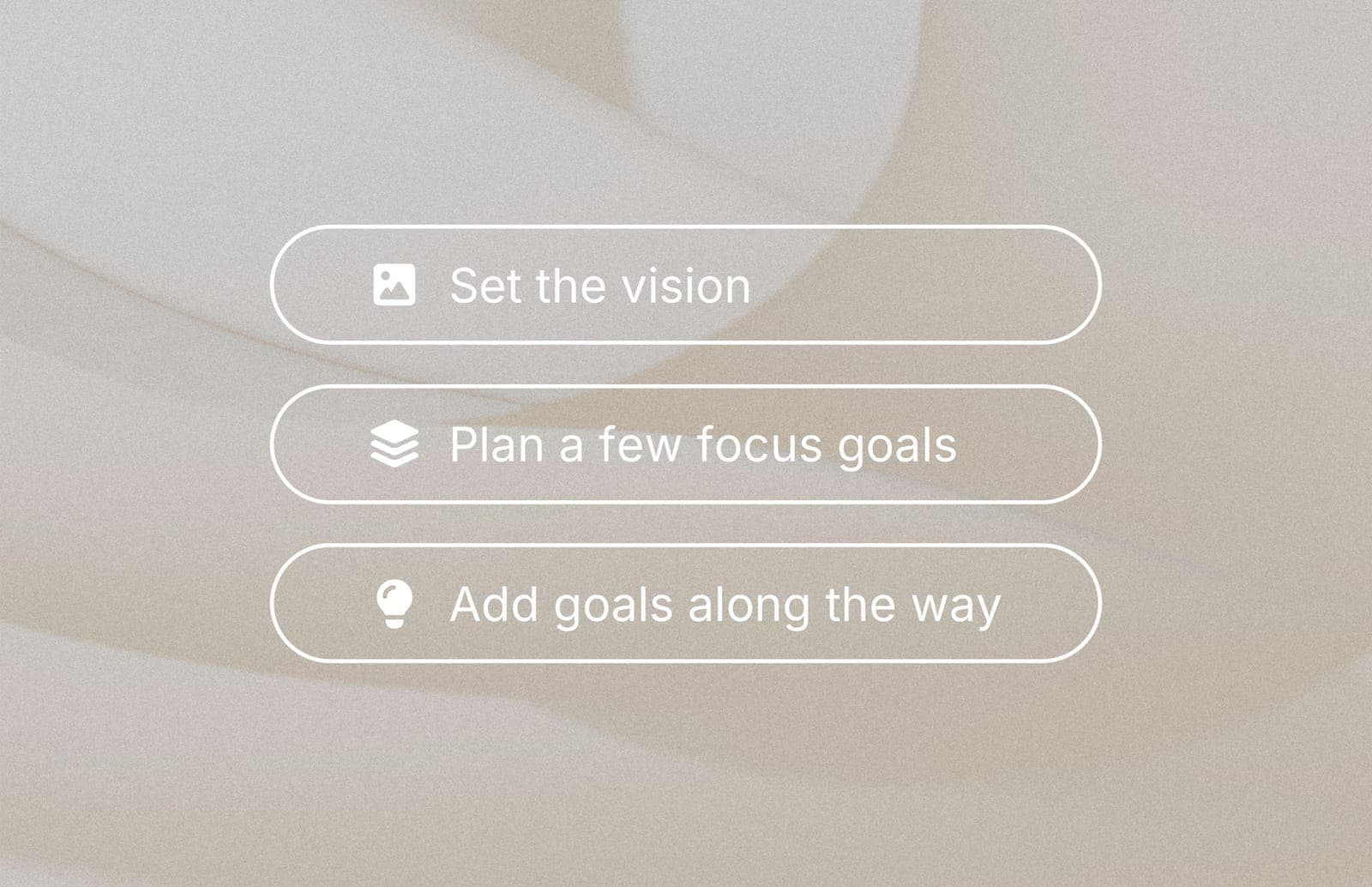
- Start with the vision. Name the feeling the year is moving toward. Keep that picture close.
- Pick a short list. One or two goals for this month. Next month can start clean.
- Describe each goal. Type it in plain words and let Fred draft the steps.
- Write the step as an action. "Walk after dinner" beats "be healthier."
- Put step one on a real day this week.
Approach beats avoidance. In a one-year study of resolutions published in PLOS ONE, people with approach-oriented goals were more successful than those with avoidance-oriented goals (58.9% versus 47.1%).
Specific beats vague, too. Across decades of research, Locke and Latham found that specific, difficult goals raised performance on well over 100 tasks, with more than 40,000 participants in at least eight countries (their review).
The vision keeps the reason in view. The steps keep you specific. One or two goals for the month sounds small, and that is the point. Finished goals teach you that the next one is possible.
How to stay with it after the plan exists
Drafting the plan is the easy part. Two habits do most of the rest.
The first is a monthly review. Around the middle of the month, look at what moved, keep what still matters, and let the rest go or put it on hold. A monthly review beats a resolution you only meet in January. A missed day is not a debt.
The second is one person. Tell a friend what the month is for. In Dr. Gail Matthews' Dominican University study, more than 70 percent of participants who sent weekly updates to a friend reported successful goal achievement, compared with 35 percent who kept their goals private and unwritten. One curious check-in is enough. Sharing a goal does not require an audience.
Start with Fred today
Turn your vision into goals. Fred keeps the big picture close and breaks each goal into concrete steps, generated for you and ready to start. One or two goals for the month is enough. The free plan includes up to four goals.
Open Fred, describe the goal in your own words, and start with Fred today.
Frequently asked questions
Describe the goal in plain words, let the tool draft the steps, then edit them until they fit the week you actually have.
Start with the vision, pick one or two goals for the month, let AI draft the steps, phrase each step as an action, and schedule the first one this week.
A goal-setting generator turns a goal you type into a short list of steps. It saves the hardest part, which is figuring out what to do first. You still choose which steps to keep.
Give the tool the big goal and ask for a milestone for this month, then let it split that month into steps you can start now. You do not need the whole year mapped on day one.