Lifestyle & Brand
A Wooden Sign, and the Next Hut
The last bar of signal disappeared somewhere above the tree line, and I did not notice the exact moment it went. I noticed the quiet that came after, which felt less like losing something than like setting down a bag I had been carrying without knowing.
It was late September in the Alps. The larches had started to turn, that thin gold they hold for a week or two before the wind takes it. The air up there is different. You feel it in the first hundred steps, a little sharpness in the lungs, a reminder that you are higher than your body expected to be.
I had come to walk from one hut to the next. That was the whole plan.
No summit, no loop with a name I could post later. Just a few days of walking to a place to sleep, then walking to the next one.
I am usually the person with the whole route open on a screen. I like to see the elevation profile, the total distance, the estimated hours, the way the line climbs and falls before I have taken a single step. There is a comfort in that, and there is also a weight. When you can see all of it at once, you start carrying all of it at once.
Without signal, I could not do that anymore. The map in my pocket had become paper, and paper does not scroll ahead of you the way a phone does. It shows you where you are and roughly where you are going, and then it lets you look up at the actual mountain.
By the second morning something in me had gone quiet in the same way the phone had.
A sign with one name
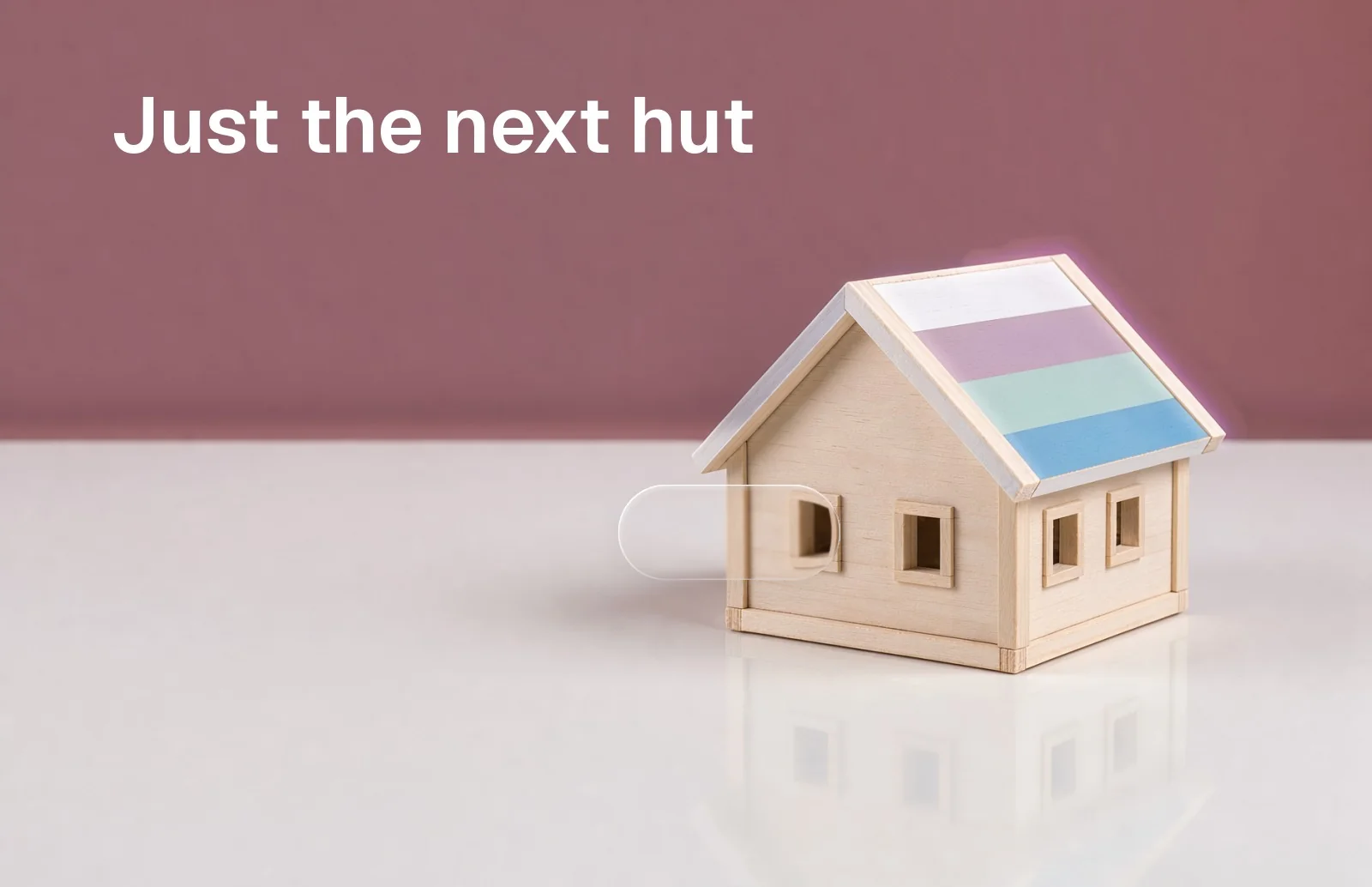
The path narrowed after a stream crossing, and I came to a junction. There was a wooden sign there, weathered pale, the kind bolted to a post and repainted every few summers by someone who cares about it. It listed one name and one number. The next hut, and the time it takes to walk there. Two hours and fifteen minutes.
Nothing about the hut after that. Nothing about the pass I would cross the following day, or the descent, or the village at the very end where the buses run. Only the next place, and how long my legs would need to reach it.
I stood there longer than the sign deserved.
Because I realized I was relieved. Two hours and fifteen minutes is a thing a person can hold. I did not have to feel the whole journey in my chest at that junction. I only had to walk to the next marker, and when I got there, another sign would tell me the next one.
There is a version of me that would have found that maddening a few years ago. Tell me everything, I would have said. Let me see the shape of the day. But standing at that post, with cold air moving down off the snow that was still up on the north faces, I understood the mountains had already made a decision for me. The route reveals itself one sign at a time whether you like it or not. You cannot see around the ridge. You just walk to the next hut.
So I did. Two hours and fifteen minutes, more or less, and the roof came into view exactly when my legs said it should.
The huts up there have a particular feeling in the evening. You arrive tired in the good way, and the first thing is a rack of boots by the stove, everyone's boots, drying and steaming a little, smelling of leather and wet wool. There is a guestbook near the door, a real one, paper and pen, where people write a line about the day or the weather or a friend they were thinking of. I read a few pages back. Someone in July had written about rain that lasted three days. Someone else had drawn a small mountain and nothing else.
I wrote my line. Then I sat with tea I did not really need, just to hold something warm.
The dark comes early up there in late September, and it comes fast, the way it does when there are no city lights arguing with it. By seven the windows had gone black and the room had gone soft and low, voices in two or three languages, the stove ticking as it cooled.
I was asleep before nine. I cannot remember the last time I slept before nine.
Only the next step
I have thought about that sign a lot since I came down. Not as a metaphor I went looking for, because I did not go up there to learn anything. It just stayed with me, the way true things do.
Most of us try to hold the whole route in our chest. The whole year, the whole vision, every step between where we stand and the life we can picture so clearly it aches a little. The clarity of that picture is a gift. Seeing the entire path at once is also the thing that stops us on the first morning. It is too much air to breathe in one step.
This is close to why I built Fred the way I did. The vision stays in view, the picture of where you are walking. The app only asks for the next hut. When a goal feels too big or too vague to start, Fred turns it into a concrete step, generated for you and ready to start. You walk to that one. Then it shows you the one after that.
A sign at a junction, painted pale, telling you one name and one time.
I am not going to pretend the mountain fixed anything permanent in me. I came home and the signal came back and the whole route started scrolling ahead of me again, the way it does. But I know the feeling now, and I can find my way back to it. You do not need to see the summit to take the next honest step toward it.
Somewhere up there the larches have dropped their gold by now, and the stove is still drying someone's boots, and the guestbook is a few pages fuller.
And the sign still says only the next hut, and how long it takes to walk there.