Goal Setting
Private Goals: Why Keeping Some Goals to Yourself Can Help You Reach Them
Every January, many of us quietly promise ourselves something. Most of those promises stay unspoken, and that is okay.
A 2024 Pew Research survey shared a telling number. It reported that "Three-in-ten Americans report making at least one resolution this year, with half of this group making more than one."
Some of those goals feel safer kept to yourself. These are your private goals, the ones you work on without an announcement or an audience.
If you have ever felt odd about not sharing a goal, this post is for you. Keeping quiet can be a smart, deliberate choice.
We build a goal app called Fred, and we keep plenty of our own goals private. Here we share why that often helps, and how to stay on track when nobody else is watching.
What are private goals?
Private goals are goals you keep to yourself instead of announcing them to others. Should you keep your goals private? Often yes, especially for the goals tied to who you want to become.
The simple rule is this. Keep your deeper goals to yourself, and share a small action goal only with a person who truly supports you.
Private goals can be personal or professional, big or small. One might be "save €2,000 by December" or "learn to drive a boat on the open ocean."
A private goal works best when you choose realistic goals that genuinely matter to you.
Why people keep their goals private
There are honest reasons to keep a goal quiet. The most common one is fear of judgment, or a pile of opinions you never asked for.
Announcing a goal can turn it into a small performance. Suddenly you are managing how it looks to other people instead of doing the work.
Maybe you shared a big plan once and lost steam when it fizzled in public. Keeping the next one private protects your motivation while it is still fragile.
Quiet also gives you space to change your mind. A private goal can shrink or grow without you having to explain the update to anyone.
A private goal should connect to your own reasons, which is also why vision boards matter for staying motivated on your own.
What the research says about announcing your goals
Announcing certain goals can quietly backfire. This is clearest with identity goals. Those are goals tied to who you want to become, like "become a writer" or "be a runner."
In a 2009 Psychological Science study, Gollwitzer and colleagues found something surprising. They reported that "Identity-related behavioral intentions that had been noticed by other people were translated into action less intensively than those that had been ignored."
In plain terms, being noticed can give you a small taste of the identity before you earn it. That premature feeling of completion can lower your drive to keep going.
Think of the friend who tells everyone about the novel and never writes it. The applause arrived early, so the work started to feel optional.
One caution here. This came from four small lab studies about identity goals and strongly committed people. It does not prove that every kind of sharing is bad.
When sharing a goal actually helps
Sharing is not the enemy. The right audience can add real support.
A 2025 study on sharing goals by Peetz, Buehler and Wells looked at this closely. Their summary put it plainly. "Four longitudinal studies (N = 1,035) examined whether telling others about personal goals enhances goal support received, goal pursuit effort, and goal progress."
The audience is what matters most. A trusted friend or partner helps in a way a public feed cannot.
Support works best when the other person wants you to win. A wide crowd of acquaintances rarely gives you that kind of care.
A light check-in is a gentle middle path between silence and a big announcement. One study on written goals and a check-in by Dr. Gail Matthews at Dominican University found this pattern.
"More than 70 percent of the participants who sent weekly updates to a friend reported successful goal achievement... compared to 35 percent of those who kept their goals to themselves, without writing them down."
That was a conference presentation, so read it as a hint rather than hard proof. This is also when talking about your goals with friends can genuinely help.
How to set and track private goals (without an audience)
Before you build your system, it helps to see how the two paths compare at a glance.
| Aspect | Sharing publicly | Keeping private |
|---|---|---|
| Motivation source | Approval from others | Your own reasons |
| Pressure | High and constant | Low and self-set |
| Support | Wide but shallow | Narrow but real |
| Privacy | Exposed | Protected |
You can build a quiet system that needs no audience at all. Here is the rhythm we use.
- Key point: Start with your vision, the feeling you want this year to have.
- Key point: Pick one or two goals for the month, not a long wish list.
- Key point: Break each goal into small steps, or let Fred turn vague goals into steps for you.
- Key point: Review on your own schedule, since monthly goal reviews keep you honest without anyone watching.
Writing a goal down and committing to it beats a vague wish. People who commit to a goal tend to do far better over time.
Norcross, Mrykalo and Blagys reported this in the Journal of Clinical Psychology. "At six months, 46% of the resolvers were continuously successful compared to 4% of the nonresolvers."
So a private goal still carries real weight when you write it down and track it. The commitment is the part that moves you, and it works even when the paper stays in your drawer.
If a step feels too big, cut it in half. A goal you keep to yourself is easy to adjust the moment it stops fitting your week.
Keeping goals private, gently
Private goals are a quiet way to protect your ambition while it grows. They are worth taking seriously.
Private goals suit reflective people who would rather do the work than talk about it. That is a real strength worth keeping.
Here is the rule of thumb. Keep your identity goals to yourself, and share a specific action goal with a trusted person when it helps.
You do not need the whole path today. Pick one small step and keep it yours. Try it this week.
Give your private goals a quiet home
This is exactly why we built Fred. It is a private, monthly goal app with no public feed.
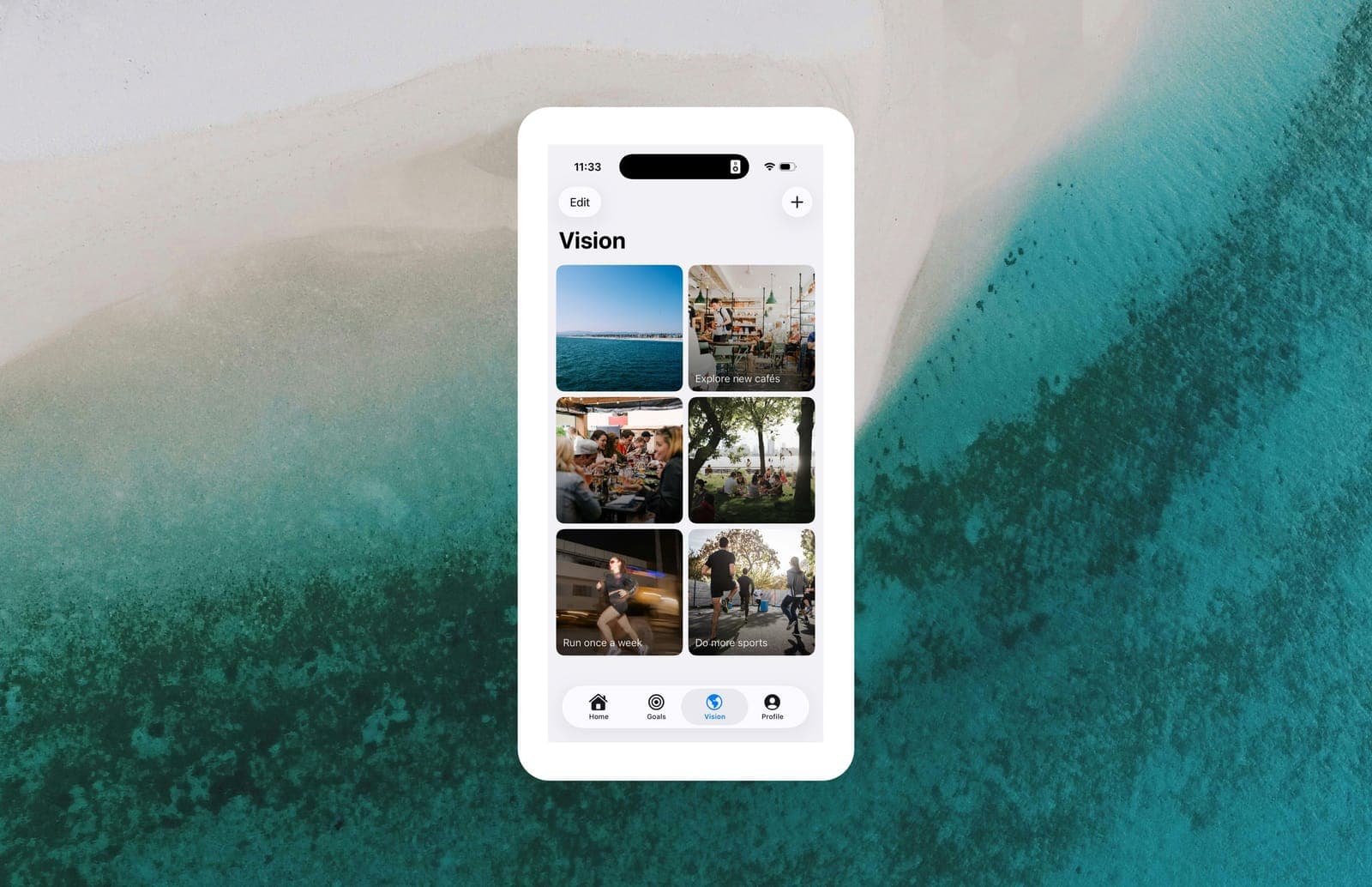
You start with a vision board and let Fred AI break a goal into small steps. Monthly reviews let you check in, and each month starts clean instead of piling up as guilt.
When you do share a goal with friends in the app, you decide how much of it they see. Share the full goal name, or show only its category, so they know the area you are working on without the detail behind it. "Health" tells them enough, while "run a half marathon before my birthday" stays yours. There is more on how that feels in practice in the Fred mobile app post.
Your goals can stay yours and still move forward. Get started today and give them a quiet home.
Frequently asked questions
It depends on the goal and the audience, so keep identity goals quiet and consider sharing a specific action goal with a supportive close person.
You protect your motivation and keep the goal genuinely yours, without inviting judgment you never asked for.
Use a simple self-review rhythm, like a monthly check-in, and track a few small steps you can finish each week.
No, because a private goal you write down and commit to still beats a vague intention you never record.